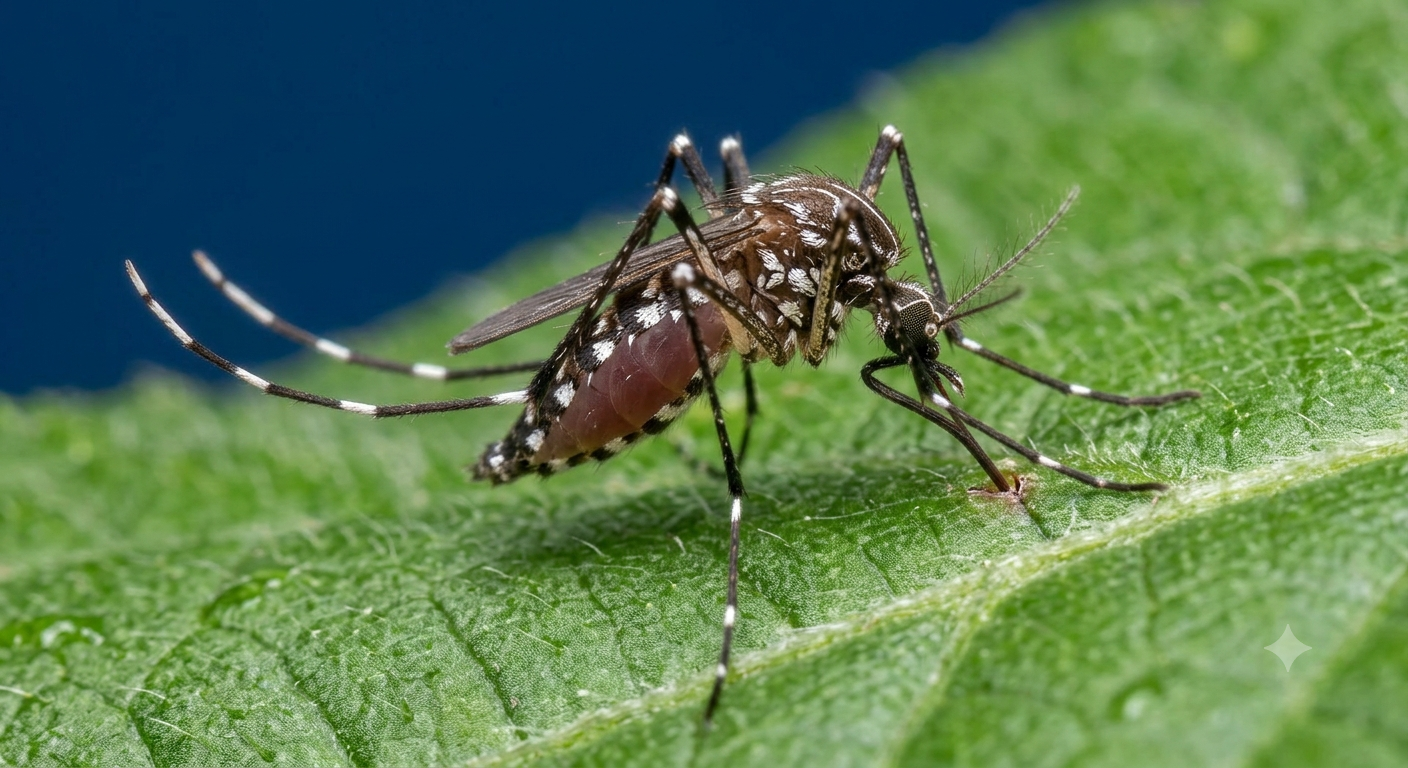
The world's deadliest animal is the size of a grain of rice
How one mosquito learned to live with us.
Around five thousand years ago, in a drying West African Sahel, a forest mosquito made a fateful bet: abandon the wild and move in with humans. That single evolutionary pivot turned Aedes aegypti into the most efficient disease vector on earth — and it is still adapting today.
Every Aedes aegypti alive today descends from an African forest mosquito, Ae. aegypti formosus — a generalist that bred in tree holes and rock pools and bit whatever wandered past.
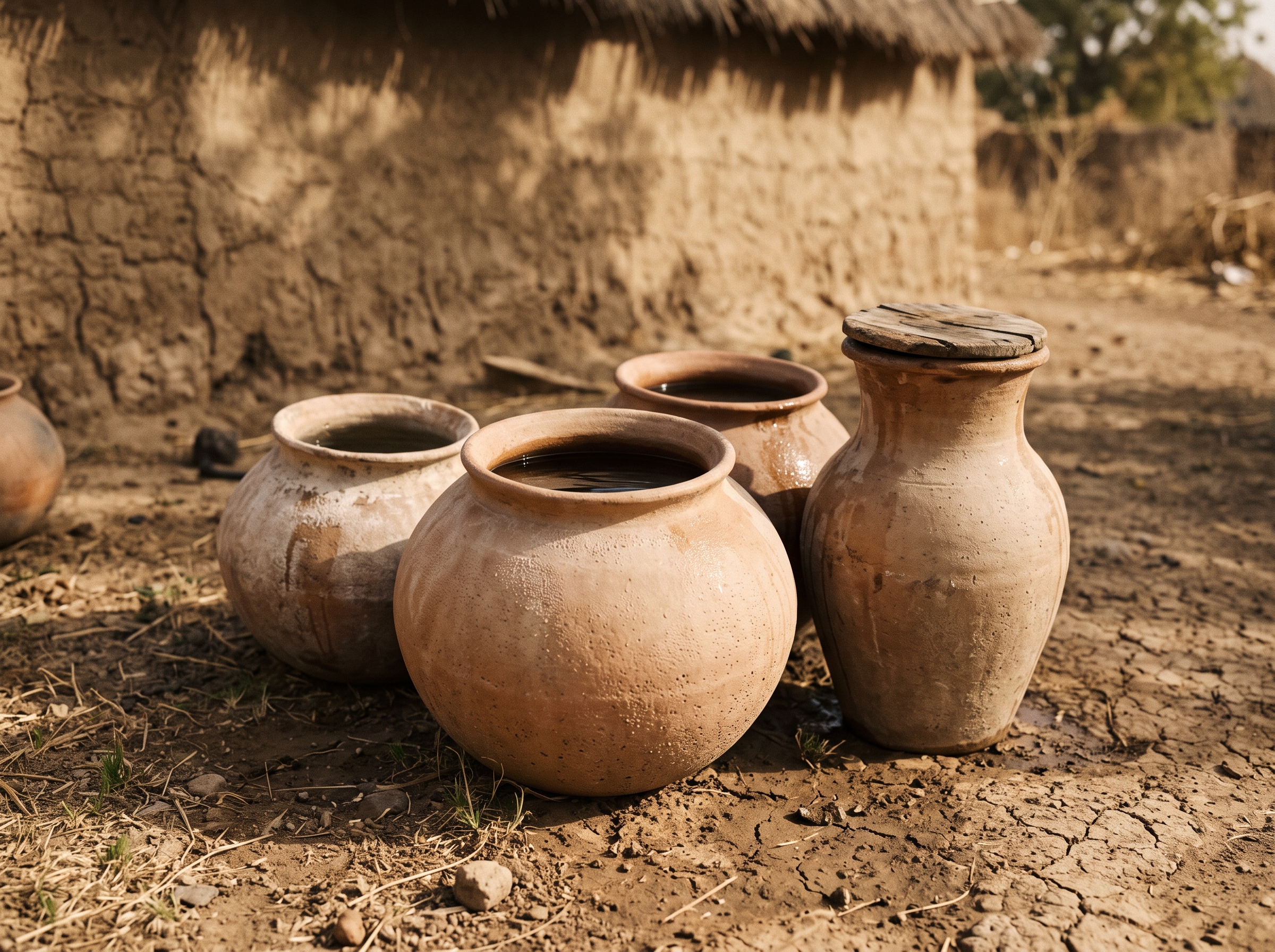
Then the climate turned. As the African Humid Period ended roughly 5,000 years ago, the Sahara dried into desert and the Sahel settled into its long, punishing dry seasons. Whole-genome coalescent analysis dates the split of the human-specialist lineage to almost exactly this moment. In a landscape where standing water vanished for months, one reliable oasis remained: the clay pots and jars in which people stored water.
The mosquitoes that learned to breed in those vessels — and to prefer the humans who filled them — gained a year-round nursery. Specialization wasn't a taste for blood so much as a real-estate decision. Biting humans came bundled with living beside them.
The human-stored water niche, c. 3000 BCE
5,000 yrDivergence from generalists
SahelWest African cradle
Clay potsThe original habitat
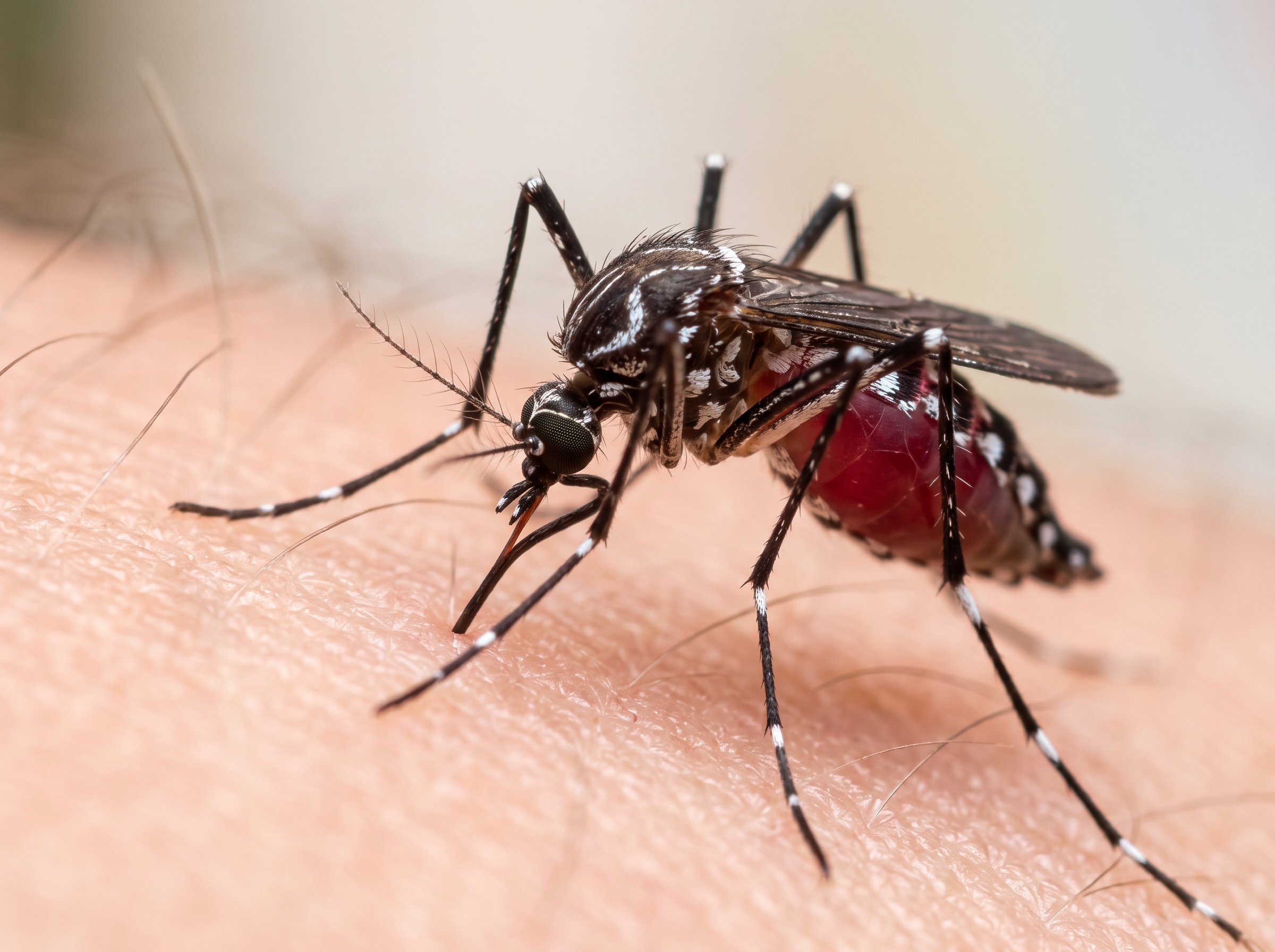
♀ onlyOnly females bite
Vector competence, up close
Why it matters
Specializing on humans sharpened the needle.
Living with people didn't just change where the mosquito bred — it upgraded it into a better vector. Human specialists bite people preferentially, feed indoors, take frequent small blood meals from multiple hosts, and breed in the containers that cluster around dense settlements. Each trait raises vectorial capacity: the mathematical likelihood that a bite will move a virus from one person to the next.
A mosquito that bites a person, rests on a wall, then bites another person days later is a far more dangerous bridge for a virus than a forest insect that mostly feeds on antelope. Human specialization, in other words, is the reason a bite from this species carries such freight.
Stage II · History
Carried in barrels, it crossed an ocean.
The mosquito's spread tracks human movement with grim precision. Its most consequential journey rode the ships of the Atlantic slave trade — and rewrote the history of the Americas.
c. 3000 BCE · West Africa
The human-specialist lineage emerges
As the Sahel dries, Ae. aegypti aegypti diverges from its forest ancestor, breeding in human water stores and favoring human hosts.
1500s–1800s · The Middle Passage
Passage in the water casks
Slave ships carried for months-long voyages — perfect floating nurseries. Eggs and larvae crossed the Atlantic in this cargo, seeding the mosquito throughout the port cities of the New World. Genomic clocks calibrated on this exact migration confirm the timing: specialists left Africa roughly 150–500 years ago.
1600s–1800s · Colonial ports
Yellow fever takes hold
With the vector established, yellow fever erupted through Atlantic port cities. Early New World outbreaks appear in the 1600s (including the Caribbean and colonial settlements), and epidemics recurred for two centuries. The 1793 Philadelphia epidemic killed roughly a tenth of the city and emptied the young U.S. capital — a disaster we now know was delivered by mosquitoes bred in shipboard and dockside water.
1881–1900 · Cuba & Panama
The vector is proven
Carlos Finlay proposed, and Walter Reed's commission confirmed, that a mosquito — not "bad air" — carried yellow fever. Mosquito control, not medicine, is what finally let the Panama Canal be built.
Last 20–40 years · African cities
A second, modern shift
Genomic data reveal a fresh chapter: rapid urbanization is now driving human-specialist genetics back into booming West African cities, making once-mixed urban populations bite humans more. Evolution here isn't ancient history — it's happening in real time.
The engines
Climate and concrete are widening the door.
Climate change extends the season
Warmth is this mosquito's accelerant. speed larval development, shorten the time between blood meals, and — critically — shrink the extrinsic incubation period, the days a virus needs to mature inside the mosquito before it can be transmitted. Warmer nights and longer summers push suitable conditions to higher latitudes and elevations that were once too cold to sustain the vector.
The result is a widening envelope: more weeks per year when transmission is possible, and more of the map where the mosquito can survive. Erratic rainfall helps too — droughts push people to store water, and floods leave containers brimming.
Urbanization builds the habitat
This is the ultimate city animal. It breeds in exactly what dense, under-served urban growth produces in abundance: discarded tires, blocked drains, flowerpot saucers, roof gutters, and open water-storage tanks where piped supply is unreliable. Every one is a nursery within flying range of thousands of people.
therefore does two things at once — it manufactures breeding sites and it concentrates the human hosts the mosquito prefers. Dense cities are how a local outbreak becomes an epidemic, and how epidemics leap between continents by air travel.
Stage III · Current spread
Now on every warm continent.
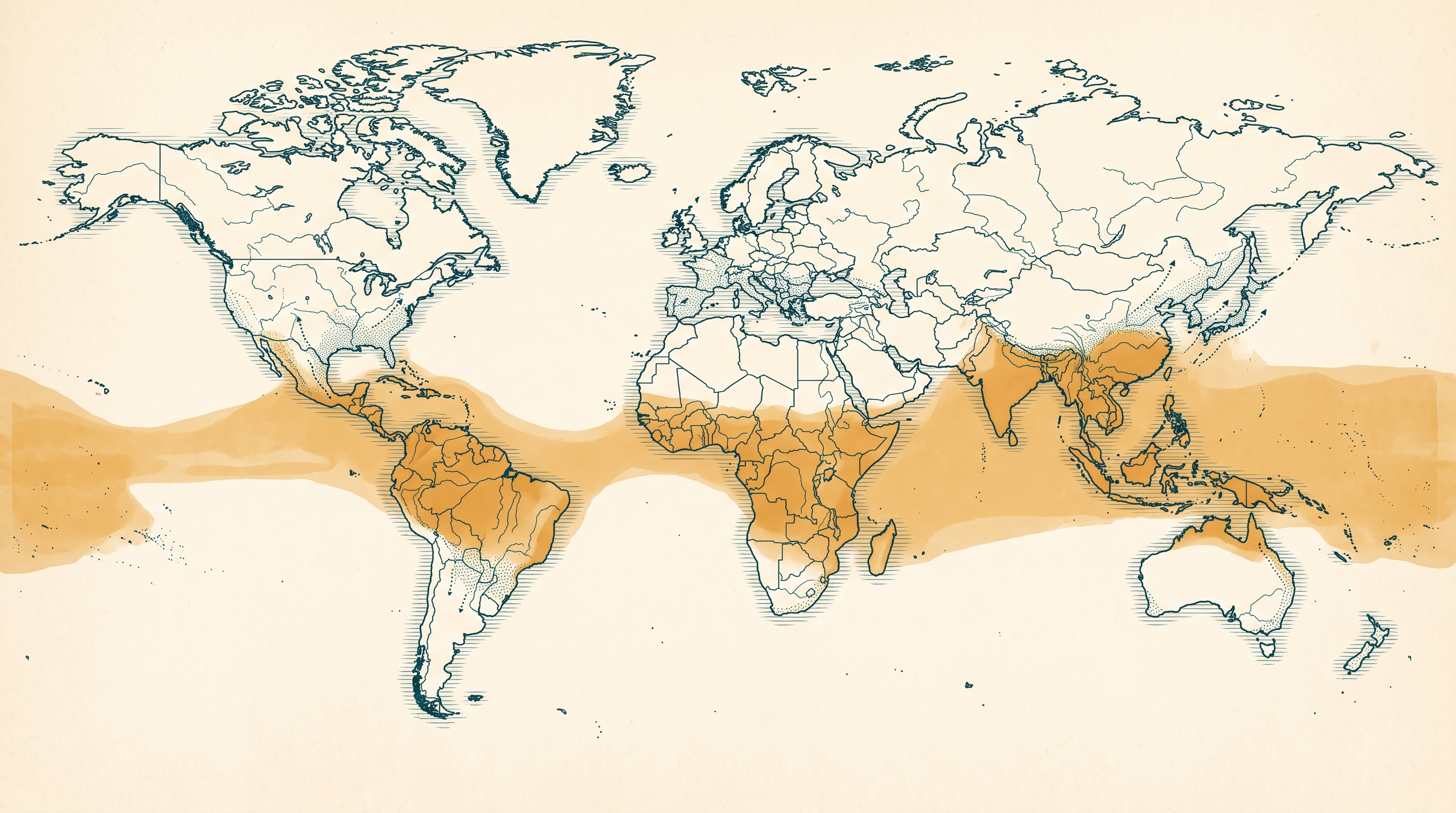
From a single West African cradle, Aedes aegypti has colonized the tropics and subtropics worldwide — and its edges keep advancing. In the United States, established populations have been detected across roughly two dozen states, concentrated in the South and Southwest, with Florida and Texas at highest risk.
Established range and advancing edge
Range by region (relative risk)
A rough sketch of where suitable conditions and vector presence concentrate today. Values are illustrative, not surveillance data.
Tropical Americas
95
SE & South Asia
92
Sub-Saharan Africa
88
US South / Gulf
62
S. Europe
34
Stage IV · The cargo
Four viruses that ride the bite.
A single competent vector can carry several unrelated pathogens. These are the major arboviruses Aedes aegypti transmits — with a note on where each stands in the United States today.
High burden
Dengue
DENV 1–4 · Flavivirus
The heaviest global load this mosquito carries — an estimated hundreds of millions of infections a year. Causes high fever, severe joint and muscle pain ("breakbone fever"), and rash; a second infection with a different serotype raises the risk of severe, sometimes fatal dengue. In the U.S., most cases are travel-associated, but local transmission recurs in Florida, Texas and Puerto Rico, and health authorities flag dengue as the most active of these threats right now.
US status
Active — local + travel
Vaccine
Limited / conditional
Historic killer
Yellow Fever
YFV · Flavivirus
The disease that made this mosquito infamous. It can progress to jaundice (the "yellow"), internal bleeding, and organ failure, with a high fatality rate in severe cases. It devastated Atlantic port cities for two centuries. Unlike the others here, it has an excellent, long-lasting vaccine — the reason it no longer circulates in the U.S., though it remains a threat in parts of Africa and South America.
US status
Vaccine-controlled
Vaccine
Yes — highly effective
Chronic pain
Chikungunya
CHIKV · Alphavirus
Rarely fatal, but notorious for sudden high fever and severe, sometimes long-lasting joint pain that can persist for months. Explosive outbreaks can infect large fractions of a population quickly. Mostly travel-associated in the U.S., with occasional local transmission in the southernmost states during warm months.
US status
Sporadic / travel
Vaccine
Newly available
Watch
Zika
ZIKV · Flavivirus
Usually mild or symptomless in adults, but infection during pregnancy can cause microcephaly and severe birth defects — the reason it triggered global alarm in 2015–16. Is it spreading or controlled? The large Americas epidemic is over: as of 2026 there are no active Zika travel notices and continental U.S. cases are rare and travel-associated. But the mosquito that carries it is still here and expanding, so Zika is best described as — a watch-list virus rather than an active outbreak.
US status
Low / travel-associated
Vaccine
In trials
Stage V · Fighting back
Turning the mosquito against itself.
Insecticides still matter, but the mosquito evolves resistance fast and hides its larvae in cryptic containers. The most promising modern tools are biological and genetic — they recruit the species' own biology to shrink or disarm its populations.
01
Wolbachia — the friendly bacterium
Naturally occurring Wolbachia bacteria are introduced into Aedes aegypti in two ways. In population replacement, infected mosquitoes are released to breed into the wild population; the bacterium blocks dengue and Zika from replicating inside them, so the mosquitoes stay but stop transmitting. Large deployments in Indonesia, Colombia and elsewhere have cut dengue sharply. In the incompatible insect technique, releasing Wolbachia-carrying males causes wild females' eggs to fail — suppressing the population outright.
02
Sterile Insect Technique (SIT)
Mass-reared males are sterilized with low-dose radiation and released in overwhelming numbers. Wild females that mate with them lay eggs that never hatch, so the population collapses over successive generations. A multi-year trial on Captiva Island, Florida released over 24 million sterile males and cut wild Aedes aegypti by up to about 79%.
03
Genetic control & gene drives
Engineered "self-limiting" males (the RIDL approach) pass on a gene that kills female offspring, thinning the biting, disease-spreading half of the next generation. On the horizon, use CRISPR to force an edit through a population faster than normal inheritance — potentially spreading disease-resistance or suppression genes — though their power makes their governance and reversibility an active area of debate.
04
Smarter detection
You can't fight what you can't find. Agencies including the CDC are developing better diagnostics and surveillance — from rapid tests that distinguish dengue, Zika and chikungunya, to genomic and trapping tools that detect invasive Aedes populations early, before they establish. Detection turns reactive spraying into targeted, preventive control.
The workbench
The transmission-window estimator
A simplified, illustrative model of how climate and city conditions widen the door for transmission. Move the controls to see how the relative risk of an Aedes aegypti–borne outbreak shifts. This is an educational toy, not a forecast.
54 / 100 index
Moderate transmission window
Conditions are workable for the vector. Removing standing water is the single highest-leverage change most households can make.
Model note: this estimator combines the inputs into a single illustrative index. It intentionally simplifies real epidemiology — actual outbreak risk depends on virus presence, population immunity, mosquito genetics, and much more. Use it to build intuition, not to assess real-world danger.
Ask the field team
Five specialists, five hard questions.
Meet the five specialists. Tap one to hear their answer — or click the highlighted terms as you read to call the right expert into the margin.