Aedes aegypti

Home / Spread over time

Five centuries of hitchhiking.

Press play to watch Aedes aegypti leave West Africa, cross the oceans, nearly vanish in the 1960s, and come back stronger. Hover or tap a country or a dated marker for details.

Interactive · 3000 BCE → 2050

Watch it take the world.

Native range Established Eradicated / disappeared Projected suitable Landmark event
—

—

    Country shading is approximate and simplified: in the US, China, Australia and Argentina only part of the country is infested. Dates are first records or certifications, not exact arrival dates.

    The engines

    Trade, concrete and
    climate open the door.

    Trade & travel carry it

    Every big jump on the map followed a shipping route: slave ships, steamships, the Suez Canal. Today its drought-proof eggs ride in used tires and potted plants, and adults turn up in aircraft cabins. Port and airport surveillance is why recent arrivals in the Netherlands and the Canary Islands were stamped out before they could settle.

    Urbanization builds the habitat

    It breeds in exactly what fast-growing, under-served cities produce: tires, blocked drains, flowerpot saucers, roof gutters, and open water tanks where piped water is unreliable. make breeding sites and gather the human hosts it prefers in the same place.

    Climate extends the season

    Warmth speeds up everything. Larvae develop faster, females bite more often, and the virus inside them matures sooner. Warmer nights and longer summers push suitable conditions to higher latitudes and elevations. Droughts push people to store water, and floods leave containers brimming.

    Modelling suggests that by 2050 Aedes mosquitoes could reach places where about half the world's population lives.

    Ada, the talking mosquito

    “I don't fly far, only a few hundred metres in my whole life. You do the long-distance travel for me.”

    Ada · Aedes aegypti
    Where it is now

    Now on every
    warm continent.

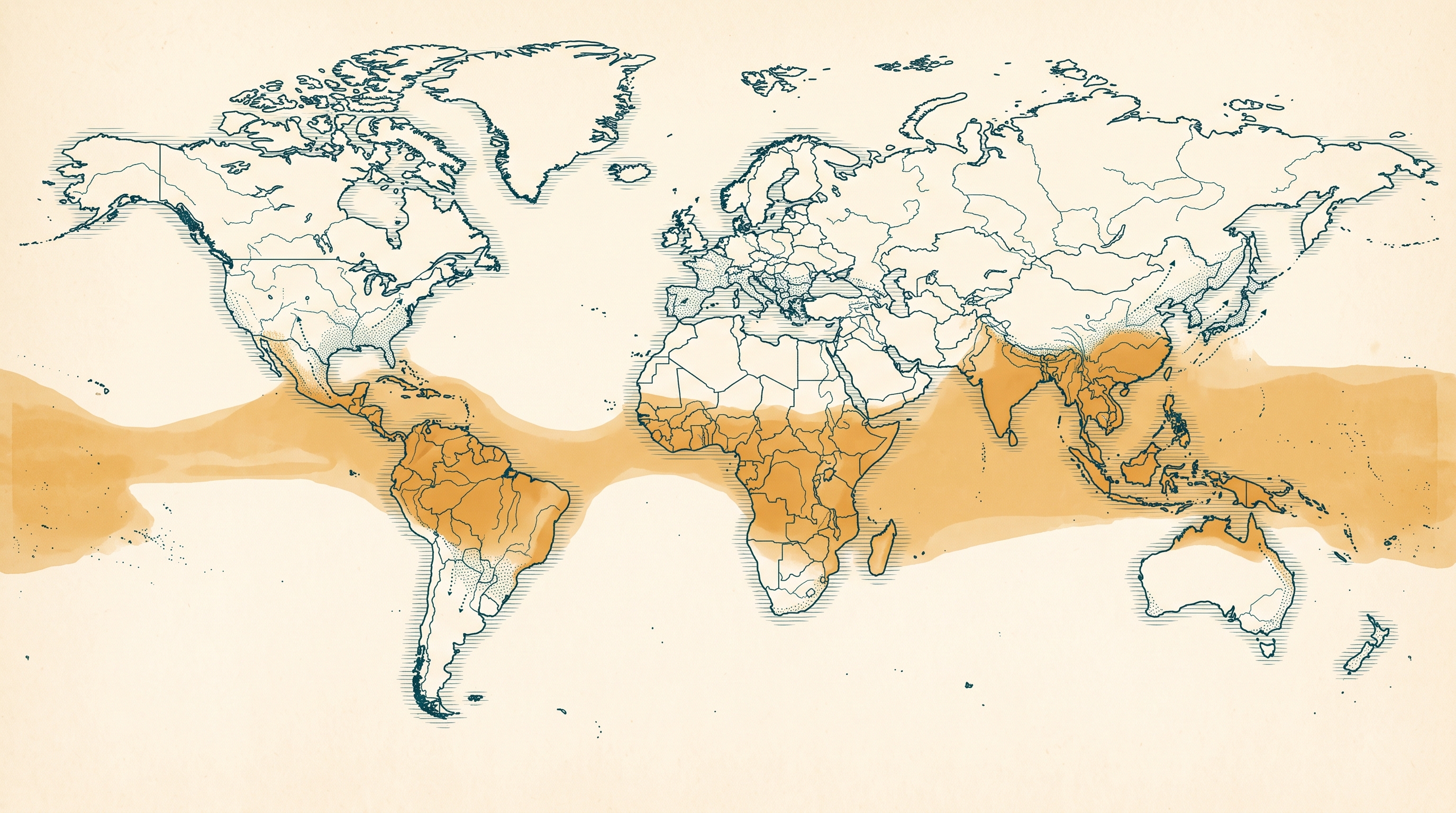
    It is established across the tropics and subtropics, and its edges keep moving. In the United States it is found mainly across the South and Southwest, with Florida, Texas and the Gulf Coast at highest risk. In California it has spread from 3 cities in 2013 to over 400 cities in 24 counties by 2024.

    Stylized world map showing the established Aedes aegypti range across the tropics in amber, with dotted arrows marking the advancing edge into the southern United States, southern Europe, and East Asia
    Established range and advancing edge

    Range by region (relative risk)

    A rough guide to where the mosquito and suitable conditions are concentrated today. Values are illustrative, not surveillance data.

    Tropical Americas
    95
    SE & South Asia
    92
    Sub-Saharan Africa
    88
    US South / Gulf
    62
    S. Europe
    34

    Note for Europe: most recent locally acquired dengue in France, Italy and Spain was spread by its cousin, the tiger mosquito Aedes albopictus. Ae. aegypti itself is so far established only in Madeira, Cyprus and around the Black Sea.

    Previous← History
    Next chapterWhy it bites you →